
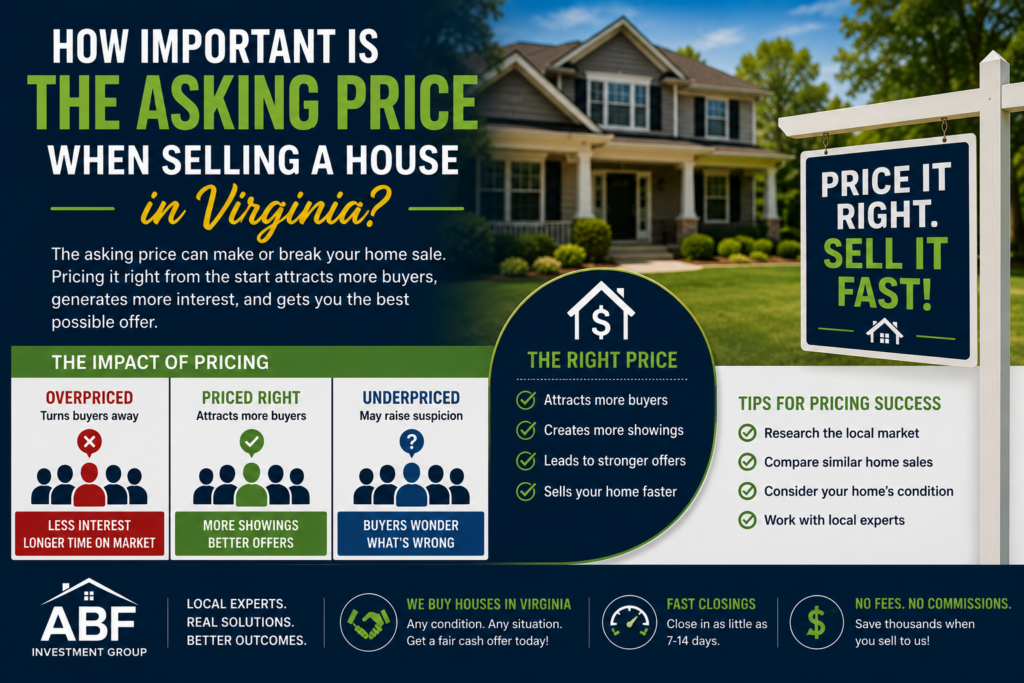
One of the first things every homeowner asks before selling is:
“How much should I list my house for?”
And honestly?
That single number creates WAY more impact than most people realize.
Because your asking price doesn’t just affect:
- profit potential
- negotiations
- buyer interest
—it actually shapes how buyers emotionally perceive your house from the very beginning.
A lot of homeowners think the asking price is simply:
“the amount I want.”
But in reality, pricing is one of the most powerful marketing tools in real estate.
Especially in competitive Virginia markets where buyers compare dozens of homes online within minutes.
And here’s the part many sellers overlook:
the asking price can either ATTRACT buyers immediately…
or quietly push them away before they ever schedule a showing.
Buyers Judge Your House Before They Even Visit It
This happens constantly now.
Modern buyers scroll through listings fast.
Usually on:
- Zillow
- Realtor.com
- Redfin
- social media
- MLS feeds
And within seconds they’re making decisions emotionally.
If your house feels:
- overpriced
- suspiciously cheap
- outdated compared to pricing
- inconsistent with nearby homes
buyers often skip it instantly.
That’s why pricing strategy matters far beyond simply “picking a number.”
The Asking Price Helps Attract The RIGHT Buyers
This is one of the biggest functions of pricing.
Different buyers shop within different comfort zones financially.
For example:
a buyer searching around $300,000 may NEVER even see your property if you list at $350,000.
At the same time, luxury buyers shopping higher price ranges may completely ignore homes priced too low because they assume:
- something’s wrong
- repairs are needed
- the neighborhood is weaker
So pricing acts like a filter.
It naturally:
- attracts certain buyers
- repels others
And honestly?
That’s not necessarily a bad thing.
The goal isn’t attracting EVERY buyer.
The goal is attracting the RIGHT buyers most likely to actually purchase the property.
Pricing Sends Emotional Signals To Buyers
This part matters heavily.
Whether sellers realize it or not, buyers interpret pricing psychologically.
For example:
If A House Is Priced TOO LOW
buyers often assume:
- major repairs exist
- the seller feels desperate
- hidden problems exist
- something must be wrong
Even if the property is perfectly fine.
If A House Is Priced TOO HIGH
buyers may assume:
- the seller is unrealistic
- negotiations will be difficult
- better options exist elsewhere
And once buyers emotionally lose interest, getting them back becomes difficult.
Overpricing Usually Hurts More Than Underpricing
This surprises homeowners.
Many sellers believe:
“We can always lower the price later.”
But unfortunately, stale listings create problems.
Because once a property sits too long:
buyers start questioning it.
They wonder:
- Why hasn’t it sold?
- Is there something wrong?
- Are inspections failing?
- Is the seller difficult?
Even price reductions later sometimes fail restoring buyer excitement fully.
That’s why strategic pricing EARLY matters so much.
Buyers Compare Your Home To Nearby Listings Instantly
This wasn’t always true years ago.
But now buyers compare properties side-by-side online constantly.
Meaning they immediately evaluate:
- square footage
- updates
- lot size
- condition
- neighborhood quality
- pricing differences
against nearby homes.
So if your house costs more than comparable homes nearby…
buyers expect a reason.
Usually:
- upgrades
- superior condition
- better location
- premium features
Without clear value differences, buyers often move on quickly.
Pricing Is Also The Starting Point Of Negotiation
Very few homes sell EXACTLY at asking price.
Most sales involve negotiation.
Meaning the asking price becomes the opening conversation.
Some sellers intentionally:
- price slightly high expecting negotiation
- price aggressively for multiple offers
- price lower for faster sales
depending on:
- market conditions
- urgency
- competition
- property condition
The strategy behind the number matters just as much as the number itself.
Emotional Attachment Causes Pricing Mistakes Constantly
This is completely normal.
Homeowners naturally value their house emotionally because they remember:
- raising kids there
- renovations
- family events
- years of effort
But buyers don’t pay for emotional history.
They pay based on:
- market perception
- current condition
- nearby alternatives
- affordability
And honestly, this emotional gap causes many pricing mistakes.
Especially when sellers rely heavily on:
- what they “need”
- what they “want”
- or what neighbors claim houses are worth
instead of actual buyer behavior.
Sometimes The Market Changes Faster Than Sellers Realize
Virginia markets shift constantly depending on:
- interest rates
- inventory levels
- migration trends
- economic changes
- seasonal demand
A house that could’ve sold instantly six months ago may struggle today at the same price.
That’s why relying on outdated comparable sales sometimes causes pricing problems quickly.
Condition And Pricing Must Match
This part matters heavily too.
If a house needs:
- repairs
- updates
- cosmetic improvements
buyers expect pricing to reflect that reality.
Today’s buyers especially prefer:
- move-in ready homes
- updated spaces
- minimal projects
because renovation costs became expensive.
Meaning fixer-uppers priced too aggressively often sit much longer.
Some Sellers Care More About Speed Than Maximum Price
Not every homeowner has months available waiting for ideal offers.
Some people face:
- foreclosure pressure
- relocation
- divorce
- inherited properties
- financial stress
And during those situations, certainty matters more than squeezing every last dollar from the property.
That’s why some Virginia homeowners eventually skip traditional pricing strategies entirely and explore direct cash offers instead.
Why Some Homeowners Skip The Traditional Selling Process
At ABF Investment Group, we work with homeowners throughout Virginia who often feel overwhelmed trying to:
- determine pricing
- handle showings
- negotiate repairs
- wait on financing
- manage uncertainty
Especially sellers dealing with:
- distressed properties
- urgent timelines
- inherited homes
- major repairs
Many people simply want:
- a straightforward offer
- a clear timeline
- less stress
- fewer complications
without months of guessing whether pricing is correct.
Final Thoughts
The asking price absolutely matters when selling a house in Virginia.
In fact, it’s one of the MOST important factors affecting:
- buyer interest
- showing activity
- negotiation strength
- overall selling experience
Because pricing doesn’t just reflect value…
it shapes buyer psychology immediately.
A strong pricing strategy helps:
- attract the right buyers
- create confidence
- position the property correctly
- generate stronger activity
At ABF Investment Group, we believe homeowners deserve honest guidance about pricing and selling options — not inflated promises designed simply to win listings.
No gimmicks.
No unrealistic numbers.
Just practical advice helping Virginia homeowners make smarter real estate decisions.